News Letter


Keep BEMT & DHHB. Lose the Yellow Stains.
- By
- Myunghee Lee
- Translated by
- Yujin choi
- September
- 2026, No.43
High-Performance UV Protection. Less Fabric Staining. Meet HYDROSOLA.
Yellow marks on the collar or cuffs of a white shirt after wearing sunscreen. For consumers, they’re a frustrating part of the experience. For formulators, the challenge runs deeper.
High-performance organic UV filters like BEMT and DHHB are essential for broad UVA coverage. Yet when these oil-dissolved filters come into contact with clothing, they can leave yellow stains. Reducing their levels raises concerns about UV protection, while keeping them means facing consumer complaints about fabric staining.
It can feel like a choice between product performance and consumer satisfaction.
What if you could keep your UV filters and reduce the yellow stains left on clothing?
What is HYDROSOLA?
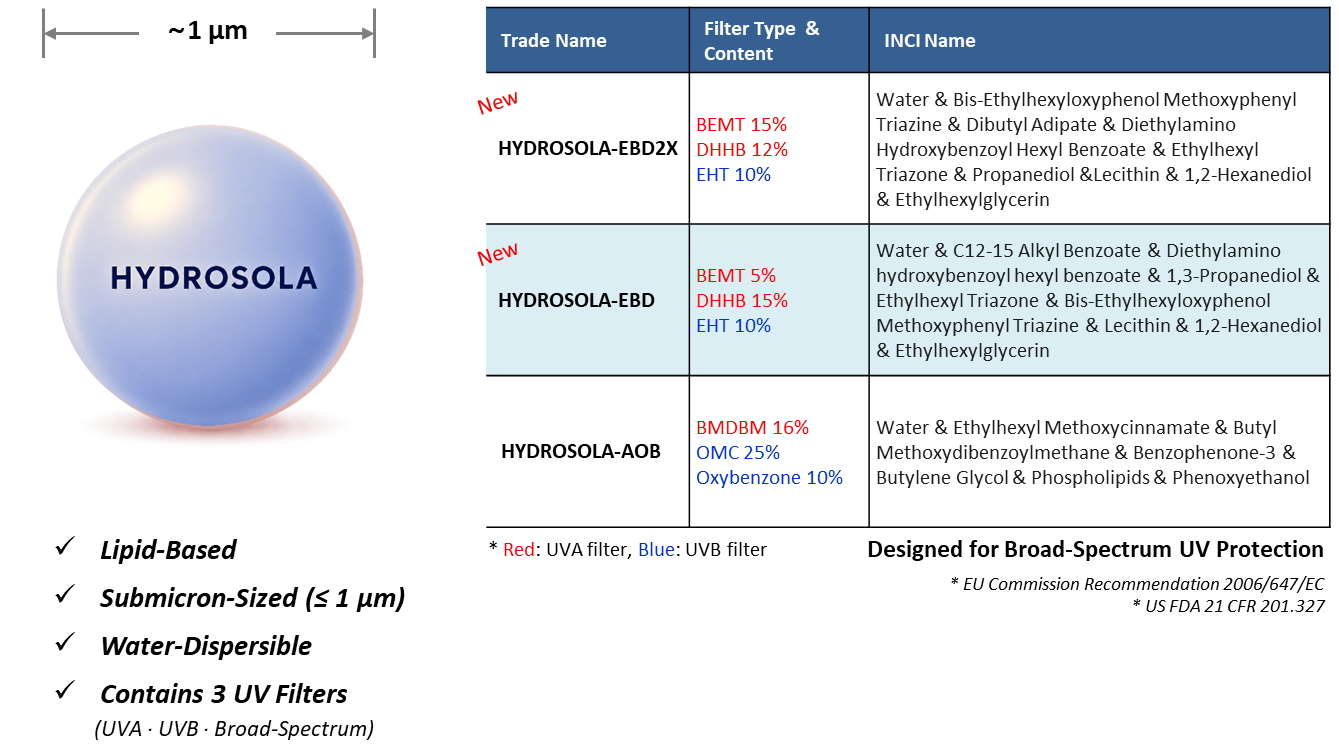
The HYDROSOLA series addresses this dilemma by changing how UV filters are carried, rather than restructuring the formulation.
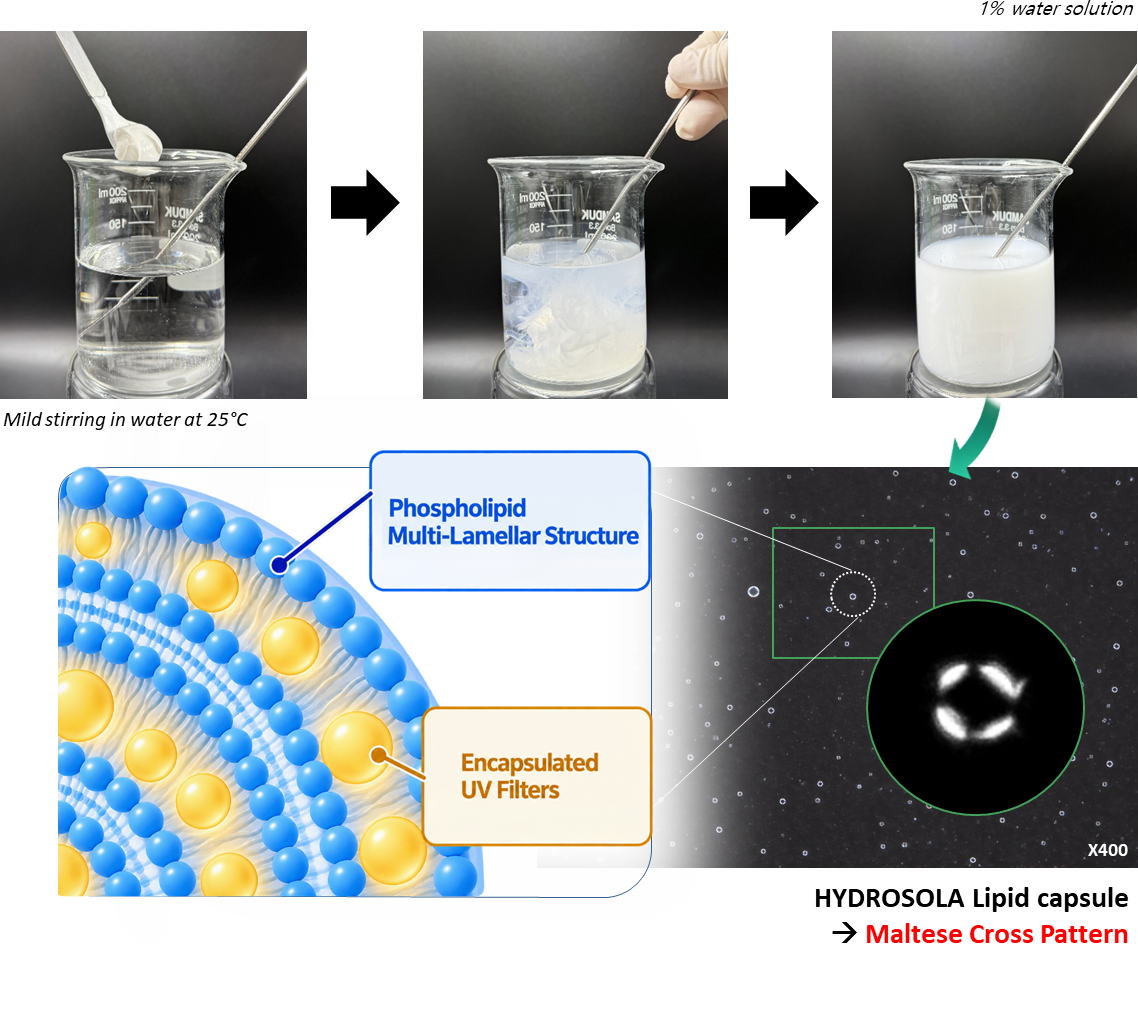
01. Phospholipid-Based UV Capsules carrying UV Filters in Phospholipid Particles
Traditionally, poorly soluble UV filters such as BEMT and DHHB are dissolved in oil. HYDROSOLA instead incorporates them into multilayered, phospholipid-based particles approximately 1 μm or smaller, allowing them to disperse readily in the aqueous phase.
HYDROSOLA-EBD and EBD2X combine three UV filters—BEMT, DHHB, and EHT within a single particle system. This design allows the filters to remain in the aqueous phase, carried within phospholipid particles rather than dissolved in oil.
02. Negative Charge—Adding a Negative Charge to the Particle Surface
HYDROSOLA goes a step beyond incorporating UV filters into phospholipid particles. In water, its particles exhibit a negative zeta potential of approximately −40 to −65 mV. The high absolute zeta potential helps suppress aggregation through electrostatic repulsion between particles, supporting stable dispersion.
Even after 13 months, HYDROSOLA maintained a zeta potential similar to its initial value, confirming that the particles retain their charge characteristics over time.
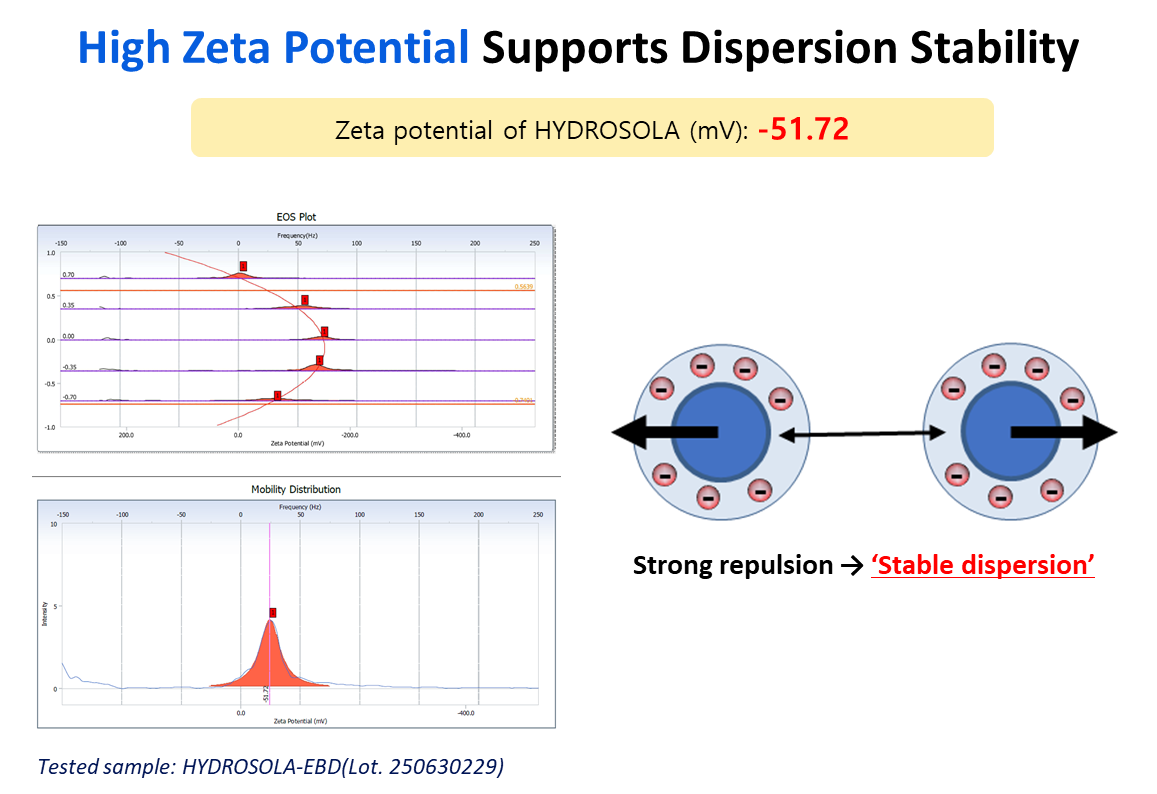
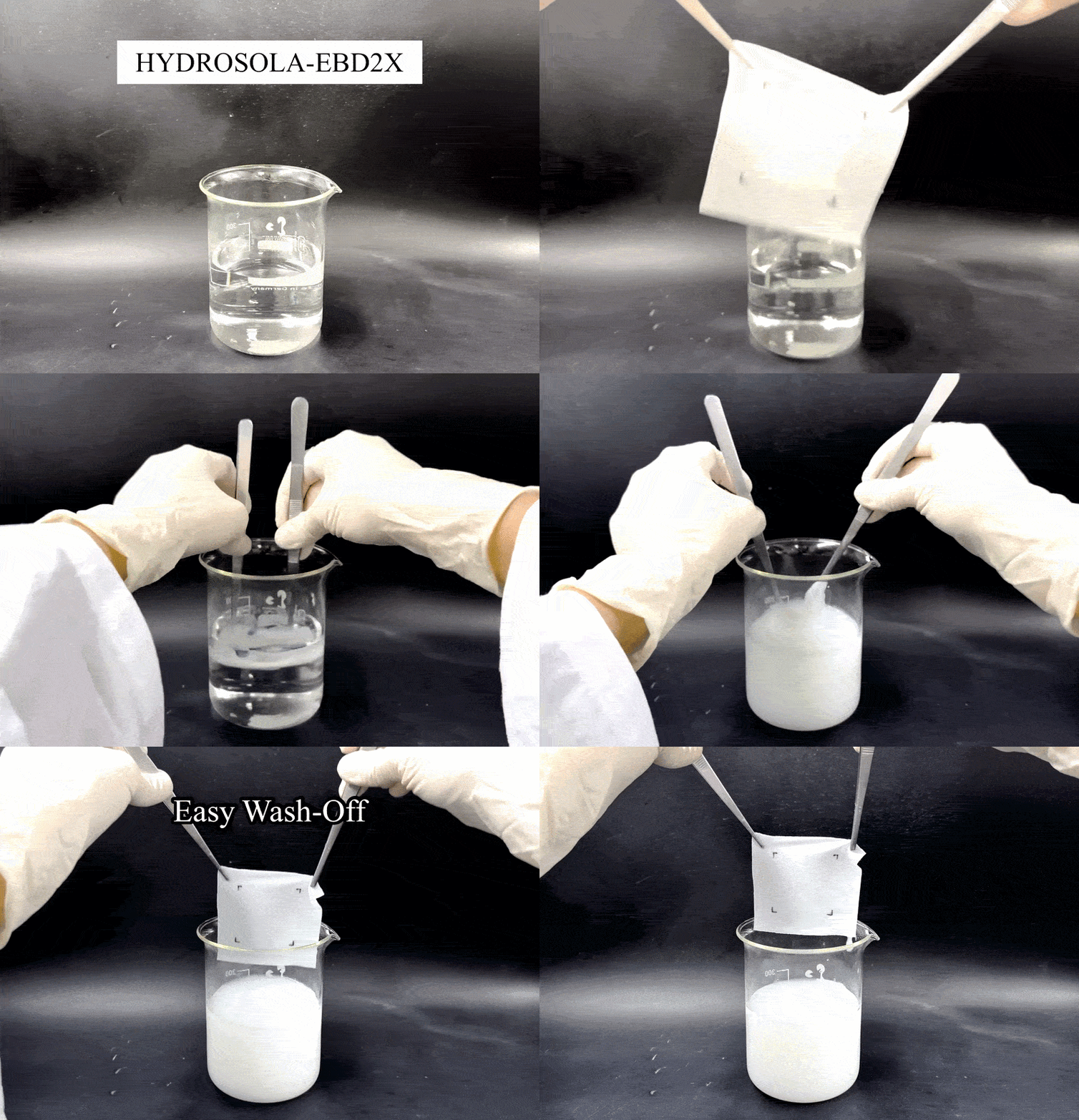
This negative charge plays an important role not only in particle stability, but also in how the particles interact with fabric.
Same UV Filters. Why the Difference in Fabric Staining?
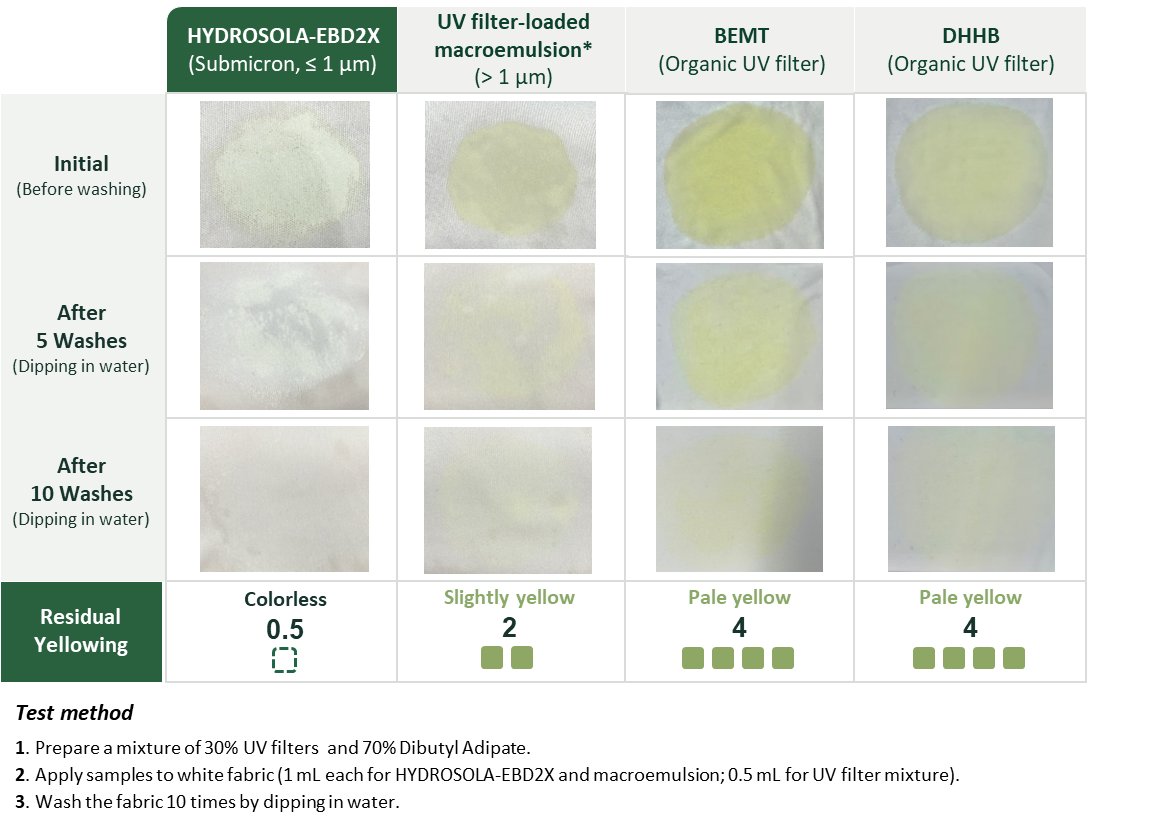
HYDROSOLA-EBD2X and the comparison samples were each applied to white fabric. The fabric was then immersed in water and removed 10 times, and the remaining coloration was compared.
The comparison samples included a macroemulsion formulated with a conventional nonionic emulsifier, as well as separate oil-based samples containing BEMT or DHHB.
What Explains the Difference?
What matters is how the UV filters are carried when they interact with fabric, rather than simply which filters are used.
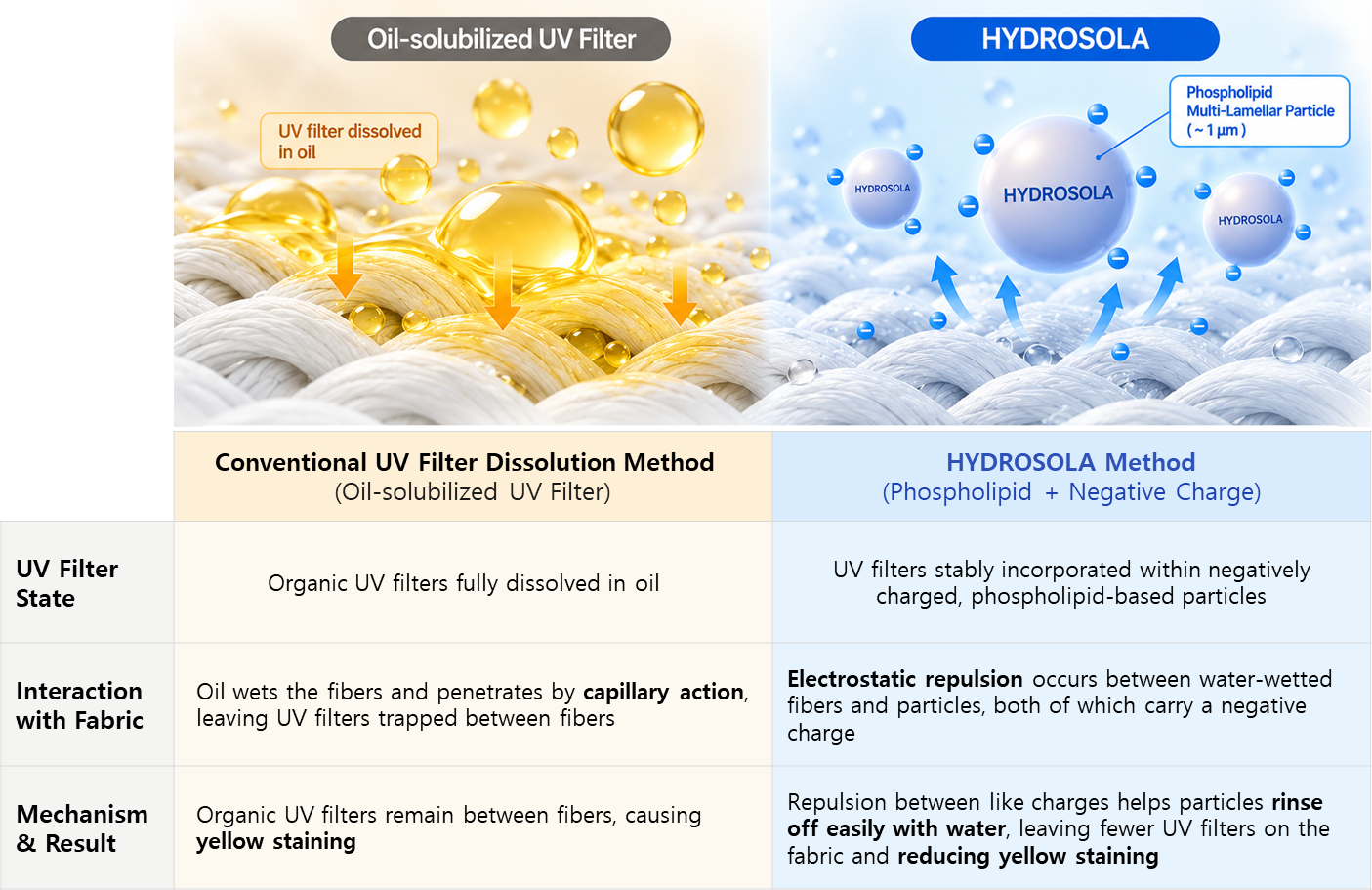
Keep BEMT & DHHB. Reduce Yellow Stains on White Clothes.
HYDROSOLA offers a new way to balance high-performance UV protection with reduced fabric staining.
Developing a low-viscosity sun serum, sun essence, or sun mist? Explore how the HYDROSOLA series could fit your formulation.
Q&A
Q. Can HYDROSOLA help reduce skin penetration of UV filters?
HYDROSOLA is designed to keep UV filters on the skin’s surface by incorporating them into phospholipid-based, submicron multilamellar particles approximately 1 μm or smaller.
Three features may help limit skin penetration: the multilamellar structure, the submicron particle size—which is relatively large compared with the lipid regions of the stratum corneum—and electrostatic repulsion between the particles and the skin. Skin permeation testing also showed lower permeation and shallower penetration compared with conventional droplets.
Q. Can HYDROSOLA be used with the water-soluble UV filter PBSA?
Yes, but pH and electrolyte levels need to be carefully controlled. First, fully neutralize PBSA and adjust the pH to 6.0–7.0. For both single-phase aqueous and O/W formulations, we recommend adding HYDROSOLA at a later stage, followed by gentle stirring.
The increase in electrolyte levels during PBSA neutralization may affect HYDROSOLA’s interfacial stability.
Q. Is HYDROSOLA stable in formulations containing electrolytes?
HYDROSOLA is relatively stable at electrolyte levels typically used in cosmetic formulations. However, high electrolyte concentrations—particularly multivalent metal ions—may affect the interfacial stability of the phospholipids.
This is a general characteristic of phospholipid-based systems. We recommend conducting preliminary stability testing for formulations with high electrolyte levels.
Areum Jeong / Regional Sales Manager
E-mail : sales1@sunjinbs.com
E-mail : sales1@sunjinbs.com